The Bench Behind the Stage: American Workshops That Keep Indian Instruments—and Their Players—Playing
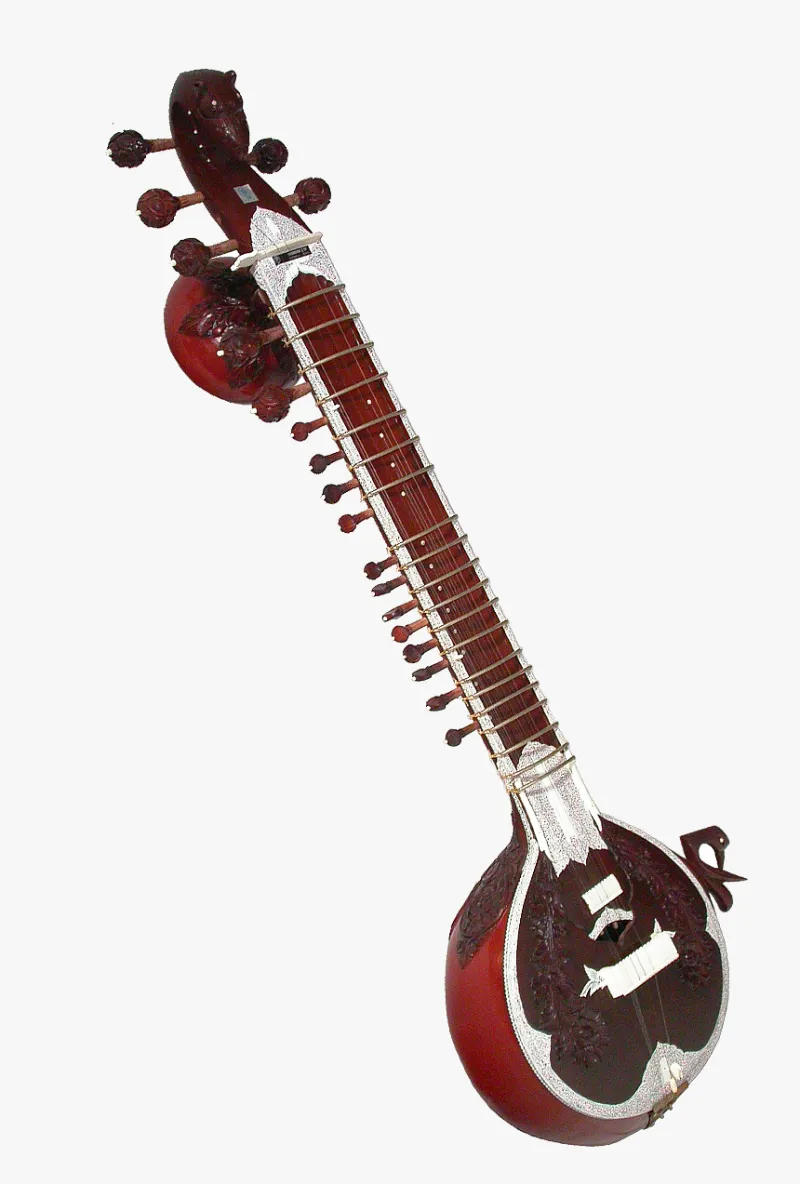
Photo: sitar repair luthier workshop hands strings bridge close-up, via www.pngitem.com
It's January, the indoor humidity is somewhere around 22 percent, and there's a sitar on the bench with a hairline crack running from the gourd to the neck. Its owner, a twenty-something player from Minneapolis, drove nine hours to leave it here. She'll drive back for it in six weeks.
This is the quiet second economy of Indian classical music in America: the repair bench. Not the concert hall, not the festival stage—the converted garage, the back room of a music store, the shop with a lathe and a stack of goat skins and a waiting list that runs into spring.
The problem is the weather, mostly
Sitars, sarods, tampuras, mridangams, tablas, and harmoniums were not designed for forced-air heating. A mridangam's heads are stretched hide, and hide tightens and slackens with the seasons. A sitar's jawari—the careful curve of the bridge that produces its buzzing, blooming sustain—can shift when the wood moves, and wood moves constantly in a US climate that swings from humid summers to bone-dry winters.
"People call me in February convinced their instrument is broken," says one technician who works out of a garage in Fremont, California, and who asked to be described by city rather than name. "It's not broken. It's dry. Bring it inside, put a humidifier in the room, don't leave it in the car."
Then there's the paperwork. Indian rosewood (Dalbergia latifolia) has been subject to CITES trade protections since 2017, which means an instrument made of it crossing a border involves permits and, sometimes, a long conversation with a customs officer who has never seen a sarod. Repairers now spend as much time on documentation as on wood.
Who's actually at the bench
The people doing this work rarely trained as luthiers in the Western sense. They're retired engineers who grew up around the instruments. They're second-generation musicians who got tired of shipping everything back to Chennai. They're percussionists who learned to re-head a tabla from a maker in Kolkata over months of video calls and one very memorable visit.
In the Houston area, one repairer keeps a chest freezer's worth of drum skins and a dehumidifier cabinet, and takes in chendas for the Kerala temple festival circuit each fall. In the Chicago suburbs, a harmonium specialist reeds and tunes instruments for kirtan groups, school programs, and at least three dance academies that need reliable pitch for class. In Queens, a shop that started with guitar setups now handles veena refrets and has become the default referral for anyone within a two-hour radius.
None of them will tell you it's lucrative. Parts take weeks to source, margins are thin, and the skills get handed down in ones and twos. But the work has a gravitational pull.
When the repair shop becomes a room
What's changed in the past few years is what happens after the pickup.
Several of these shops now run free clinics before the fall festival season—bring your instrument, learn to tune it, learn what a crack sounds like versus a loose bridge. Others host open jam sessions that start around 7 p.m. and are still going at eleven, with a tabla player, two students, and whoever wandered in off the street. One workshop has been recording short oral histories with local makers and elderly players, mostly on a phone, mostly unedited, because nobody else is doing it.
The result is a set of small, unglamorous cultural hubs that don't look like cultural hubs. There's no grant plaque on the wall. There's a bench, a kettle, and a loose understanding that if you're here, you might as well play something.
For audiences, this matters more than it sounds. A regional art form survives on instruments that work. A student who can't get a mridangam re-skinned within driving distance quits. A touring artist who can't fix a cracked gourd mid-tour cancels. The bench is infrastructure.
What it costs, and who pays
A re-head on a mridangam typically runs a few hundred dollars plus materials; a jawari adjustment on a sitar is a fraction of that but requires a level of feel that few people have. What's genuinely scarce isn't money—it's hands.
"I've got maybe ten years of doing this at this volume," says a tabla technician in Edison, New Jersey, who learned syahi application from a family of makers and now teaches two teenagers on Saturday mornings. "So I'm teaching. That's the whole plan."
How to use your local bench
If you own an instrument—or inherited one from a relative who brought it over in 1974—a few practical notes:
- Ask before you DIY. Every repairer has a story about a bridge sanded by an optimistic owner. A jawari is not a home project.
- Find your person before you need them. Waitlists are real, and the fall festival season is the worst time to discover a crack.
- Talk about humidity. Most problems are climate problems. A $40 humidifier beats a $400 repair.
- Ask if they host anything. Clinics, sessions, and listening nights are usually announced by word of mouth and text message, not on a website.
- Bring the kids. The Saturday-morning teaching pipeline is how this survives.
The stage is the bench
The strange thing about watching a repairer work is how much it resembles performance: the concentration, the small adjustments, the tuning by ear until something locks. Then someone picks up the instrument, plays four notes, and grins—and for a second the shop is a concert hall with better lighting.
That's the thing about regional arts in America. The stage gets the review, but the bench keeps the lights on.